



- The June 2026 Federal Open Market Committee (FOMC) meeting marked a new era for the United States Federal Reserve and a stark departure from the previous regime.
- New Fed Chairman Kevin Warsh made it clear that communication would be simple and direct and that investors should expect less nuance and less forward guidance.
- Beyond the changing communication style and a renewed commitment to fight inflation, the Fed is looking toward a broader reset of its entire framework.
The rate environment shaped by Warsh’s inflation-first framework has direct implications for credit markets, including the private credit market, which we examine in this month’s Credit vista: Private credit under the microscope.
Economic vista: The Fed passes the baton
Jon Schwartz, Senior Portfolio Manager
Kevin Warsh’s first FOMC meeting in June 2026 signaled a clear break from the previous policy regime – not through a rate change, but through a fundamental shift in how the Fed communicates, operates and defines its institutional priorities1. In our view, this marked a distinct inflection point – not so much in near-term policy, but rather in the broader focus, communication strategy and institutional direction of the Fed under new leadership.
Simplicity, discipline and a focus on inflation
From the outset, it appeared that Chairman Warsh was setting a new tone emphasizing a more disciplined and direct policy approach. The accompanying FOMC statement was notably simplified, adopting a “just the facts” tone that stripped away interpretive language and reduced reliance on implicit signaling. This shift appears intentional and reflects Warsh’s preference for clarity and precision over the more layered communication style of previous leadership. Less nuance equals less confusion in the eyes of the new regime.
The Committee’s decision to hold rates was unanimous, further reinforcing a sense of alignment early in Warsh’s tenure. Importantly, the messaging around inflation was both firm and unambiguous. Warsh underscored the Fed’s commitment to its 2% inflation target, framing inflation control not as a passive outcome, but as an active policy objective. His statement that “inflation is a choice – we are going to get there,” communicated a high degree of conviction and a willingness to maintain policy restrictiveness as needed. Of course, the Fed’s dual mandate remains unchanged, but it seems to be emphasizing price stability over full employment.
Despite the new communication style, the Fed’s most recent assessment of the economy showed that it remains broadly stable. Labor markets continue to hold up well, in its view, with continued job creation and a largely unchanged unemployment rate. This provides the Fed with the flexibility to maintain a more restrictive policy without immediate concern about labor market deterioration. At the same time, Warsh made clear that persistently elevated prices remain a central challenge, perhaps even more so after the energy price increase earlier this year. The framing of inflation as a burden on households reinforces the prioritization of price stability within the dual mandate. In practice, this suggests that Warsh is willing to tolerate continued tight policy conditions until there is clear and sustained progress toward the inflation target. In the reality of the bond market, this likely indicates slightly higher yields for longer.
The end of Fed forward guidance
One of the most important changes being introduced in the new Warsh era is the move away from traditional forward guidance. The Committee explicitly acknowledged that forward guidance has been stepped back, marking a significant departure from the communication tools that defined the post‑Global Financial Crisis (GFC) and post‑pandemic policy environment. Under Warsh, policy signaling appears to be shifting toward a more discretionary, data-driven framework, where future decisions will be less recommitted and more contingent on evolving conditions. This will reduce the predictability of the policy path but increase flexibility, which is consistent with Warsh’s long-standing views on the limits of rigid policies. While the Summary of Economic Projections (SEP) remains in place, Warsh implied that its role, along with broader communication tools such as press conferences, may be revisited as part of a broader review. Markets and Fed watchers need to be ready for this evolving communication style.
Five task forces: A “first principles” rebuild of the Fed
Perhaps the most consequential takeaway from the June 2026 meeting was Warsh’s introduction of five internal task forces, which collectively signal a comprehensive reexamination of the Fed’s operating framework. This initiative reflects Warsh’s emphasis on returning to “first principles,” as he calls them, and modernizing the institution for today’s oft changing and dynamic economic landscape.
The five areas under review are:
- Communications: Change is already in the air, and Warsh wants to assess and improve how the Fed communicates policy, including the future role of forward guidance.
- Balance sheet policy: The Fed wants to evaluate some of its tools beyond simply setting the policy rate, and it’s reviewing the benefits and long-term structure of the ample reserves regime.
- Data and measurement: Along with more straightforward communication, the Fed wants to consider incorporating new data sources and improving methodological approaches to setting policy.
- Productivity and labor: Among other areas of emphasis, the Fed will be analyzing the economic impact of technological change, including how AI might reshape productivity and labor markets.
- Inflation framework: With its stated primary focus, the Fed is reassessing inflation dynamics and policy tools from foundational principles.
Each task force will be led by subject matter experts and produce recommendations aimed at ensuring the Fed remains “fit for purpose” in a rapidly evolving economic environment. Warsh stressed that these groups would start from first principles rather than incremental adjustments. This simply underscores the scale of the potential reset for the central bank. Taken together, these changes point to a broader institutional shift under Warsh. The Fed is not simply adjusting policy within an existing framework – it is actively reconsidering the entire framework itself. This aligns with Warsh’s long-standing emphasis on transparency, accountability and the need for central banks to adapt to structural economic changes rather than rely on legacy models. The planned review of the Fed’s communication tools, including the SEP and press conference structure, is expected to be complete by year end, and it clearly indicates the priorities and potential scope of this reset. Markets are effectively being presented with a “new chapter” for the central bank, with less focus on predefined policy paths and greater reliance on real-time data and assessment.
Implications for markets
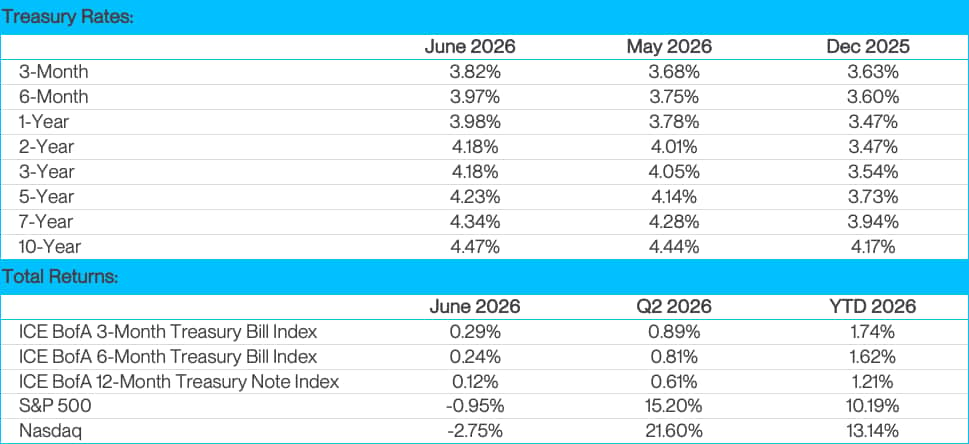
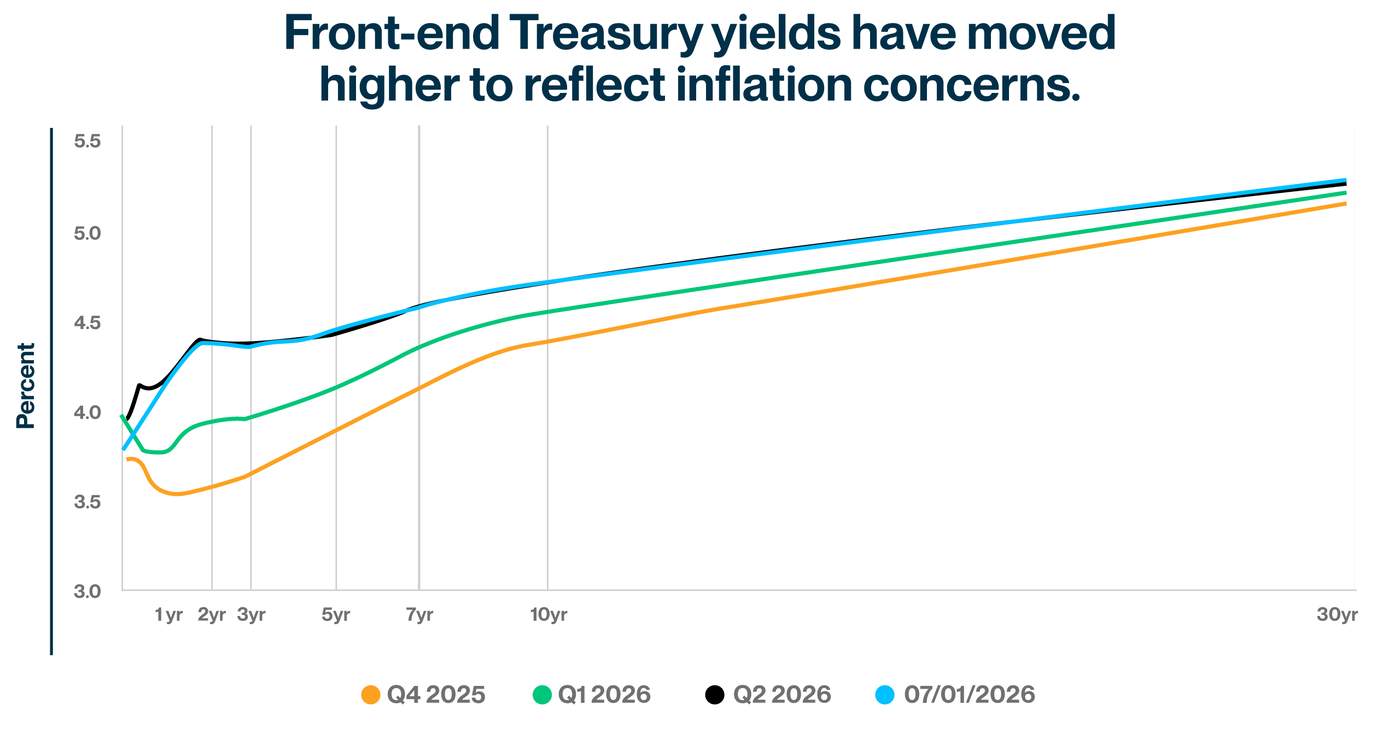
From a market perspective, messaging around price stability resonated most with investors. Expectations for rate hikes increased, which pushed rates higher across the curve. Warsh’s strong commitment to achieving 2% inflation reinforces a higher-for-longer bias. The bar for policy easing remains high, and any shift toward accommodation will require clear evidence of sustained disinflation. Furthermore, the introduction of these task forces presents an additional layer of medium-term uncertainty, as potential changes to the Fed’s framework – particularly around the balance sheet and inflation targeting – could materially affect how policy is conducted.
Bottom line
Warsh’s first FOMC meeting conveyed a decisive shift in both tone and direction. While the policy rate remains unchanged, the broader message is evident: The Fed is entering a period of structural reassessment and recalibration. Under Warsh, the Fed is moving toward a more disciplined, less prescriptive policy framework – one that prioritizes clarity, flexibility and a reexamination of first principles. For markets, this implies a transition away from the predictability of forward guidance and toward a regime defined by greater discretion, stronger inflation commitment and a deeper institutional reset. Of course, we’ll be watching to determine how it ultimately affects yields, all areas of the bond market and specific portfolios.
Credit vista: Private credit under the microscope
Darrell Leong, CFA, Managing Director, Head of Investment Research
Private credit has been in the news off and on this year – and that’s not necessarily a good thing. Some are wondering if this nuanced area of the lending universe is providing a valuable service connecting borrowers with new capital sources, while also offering investors a way to capture potentially attractive yields. Others, however, may be wondering if it is a dicey corner of the shadow banking system flashing danger signals.
Since private credit has become a major discussion point this year, we wanted to shed some light on this asset class and provide an overview of how it works. Importantly, SVB Asset Management does not currently offer or distribute private credit investments; however, we continue to monitor the asset class closely, given that it may have ramifications for the broader fixed income landscape.
What is private credit?
Private credit can have different meanings depending on one’s perspective. SVB Asset Management views private credit as a loan or credit instrument made by a non-bank institution or group of non-bank institutions to a company. Private credit has grown rapidly as companies and other borrowers seek non-bank sources of capital to support their needs. Following the GFC of 2008, traditional banks scaled back their lending efforts amidst a stricter regulatory environment and bank consolidation. Investors such as private equity firms and investment funds stepped in to fill this lending gap.
Categories of private credit
There are different types of private credit targeting different types of potential borrowers and, in turn, providing different rates of return to investors. As always, it’s a risk vs. reward tradeoff. Some of the key areas of private credit include:
- Direct lending – Private loans made directly to companies, often involving a private equity firm, are based on cash flows, the enterprise value of the company and assets such as receivables, property, plant and equipment, etc. Generally, direct lending asset managers raise money from investors through a private credit fund or a business development company (BDC). Today, this segment of private credit has grown to an estimated $2T asset class.2
- Asset-based lending – Private asset-backed lending invests in diversified pools of assets supported by contractual cash flows. These secured assets cover a broad range of industries such as auto, consumer, equipment leasing, commercial mortgages, collateralized loan obligations and more.
- Real estate debt – Private loans are made to property owners or developers, secured by commercial or residential real estate properties.
- Infrastructure lending – Private lending is used to fund the purchase or development of infrastructure assets, including transportation, data centers, energy and more.
BDC provides the bridge
A BDC plays an important role in private credit and is typically created as a bridge to provide direct funding for small- to medium-sized businesses. Created by Congress in 1980 with the Small Business Investment Incentive Act, a BDC is a closed-end, unregistered investment vehicle providing investors access to a diversified pool of private company assets. The legislation aimed to boost job growth by encouraging BDCs to fund small- and medium-sized businesses struggling to secure debt and equity financing after the 1970s recession and energy crisis.
BDCs primarily focus on providing non-investment-grade direct loans to small- and medium-sized businesses. The BDC may use leverage, up to a maximum of two-to-one debt to equity, by borrowing to make more loans to businesses, allowing them to expand their investment capacity and increase returns.
Regulations still matter
Although some critics claim that private credit is an unregulated corner of the lending universe, that’s not entirely true. Even though private credit does not have to comply with all the strict lending rules facing banks, there are regulatory guardrails that cover several areas, including:
- Income distribution – The BDC must distribute at least 90% of its taxable income to shareholders and, as a result, offers high-income yields to investors.
- Asset allocation – The BDC is required to invest 70% of its assets in qualifying assets, which are typically private US companies or small public US companies with a market capitalization of less than $250M at the time of investment.
From an investor’s perspective, BDCs may be attractive investments for those who seek high yields as they pass through income generated from a diversified pool of direct loans to private companies. The higher yields exist to compensate investors for investing in riskier, smaller companies that may not qualify for loans under stricter underwriting criteria of traditional banks. It also aims to compensate investors for the lack of transparency and provide a premium for illiquidity.
Redemption features and liquidity risks
In considering private credit investments, investors need to assess the risks. Among other key factors, there are two liquidity risks that exist concerning private credit:
- Redemption risks within some BDCs
- Liquidity of BDC vehicle
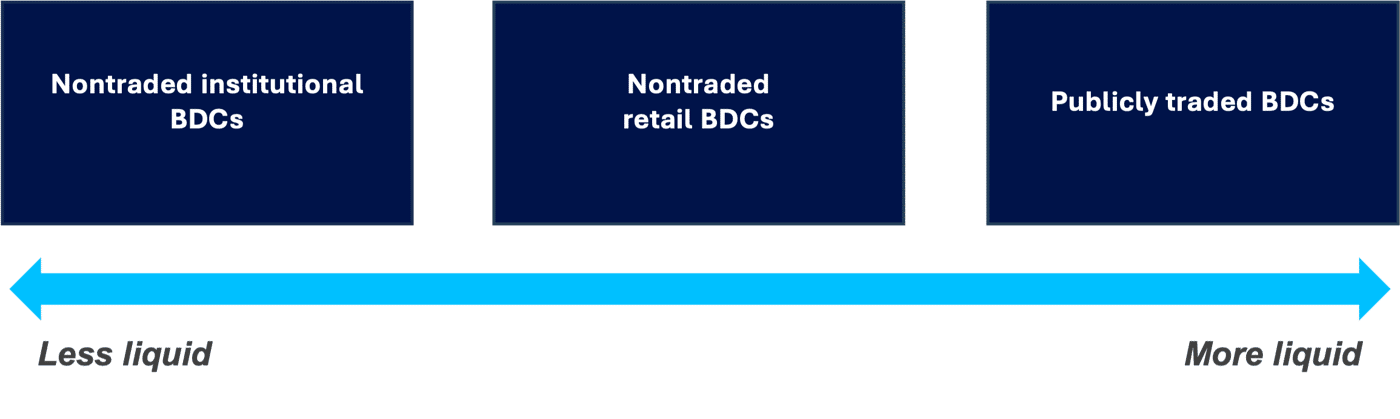
Nontraded institutional BDCs are launched by investment managers and raise capital from accredited and qualified investors. Redemptions for those funds are limited and often not permitted until the closure of the fund, which can be in the range of five to 10 years.
Typically, nontraded retail BDCs are targeted at high-net-worth retail investors. Recently, some of those vehicles have come under scrutiny given the rising number of investor redemptions, thereby suggesting some underlying concerns about liquidity caps and growing fears about underlying loan credit quality. Both market participants and the wider financial press have focused on rising redemption requests from investors in some high-profile BDCs managed by major players in the private credit arena such as Apollo, Ares, BlackRock and Blackstone. Redemptions are typically limited to 5% of net asset value per quarter and include gating features. After seeing a high level of redemption requests, some funds limited withdrawals to the amount permitted under the structure.
Not surprisingly, many publicly traded BDCs that are listed on the stock market and offer investors daily liquidity in their shares (in contrast to the illiquid nature of their underlying private credit product) have experienced elevated volatility and sharp drawdowns in price. For instance, over the past year, Blue Owl Capital Corporation (OBDC) has dropped by 28% and Blackstone Secured Lending Fund (BXSL) has declined by 27%.3
Concerns about software exposure
One of the key concerns surrounding the private credit asset class has been its exposure to the software sector, which has been roiled this year as investors wrestle with how AI might affect the traditional SaaS business model. This matters because software has become the single largest sector exposure across BDC portfolios and is estimated to represent 20%-30% of loans. Leveraged loans to private equity-backed software firms have grown significantly over the past 10 years due to the strong demand of SaaS businesses that historically have enjoyed high recurring revenue streams and solid growth rates. The peak in software buyout loans occurred in 2021 and 2022, reflecting high valuations, low interest rates and post-pandemic enthusiasm for SaaS companies.
Fast forward to today and advancements in AI have introduced a layer of uncertainty regarding the sustainability of traditional SaaS businesses, as AI-native competitors can slow growth, pressure margins and increase credit risk for some borrowers. Beyond software, other common BDC sector exposures include healthcare services, business services and financial services.
Another potential concern for private credit surrounds the typical loan structure used in lending to the software sector. Investors rely on active management by private credit investment teams to evaluate and monitor the performance of these loans. Most investments are first lien secured loans underwritten with financial covenants and loan to values (LTVs) ranging from 45% to 60%. While concerns about the credit profile of software companies are real, some take comfort in the significant equity capital supporting the loans.
There is no doubt that concentration risk across software loans is elevated and has attracted significant scrutiny. Early signs of portfolio stress have emerged within BDCs due to increases in borrowers choosing payment-in-kind instead of cash interest payments.4 But not all private credit is created equal, and it remains to be seen how this story unfolds. As always, the SVB Asset Management credit research team is monitoring developments in private credit, and we’ll be watching to see if the heightened scrutiny, liquidity risks and credit quality concerns are warranted and have ramifications or elevate volatility in other asset classes.
Markets
Source: Bloomberg and SVB Asset Management as of 06/30/2026.
Agency and Corporate Yields

Source: Bloomberg, Tradeweb and SVB Asset Management as of 06/30/2026.
Economic Indicators

Source: Bloomberg, Tradeweb and SVB Asset Management as of 07/01/2026.

