



- Bitcoin lending has emerged from the 2022 collapses of BlockFi, Celsius and Genesis, into a lending ecosystem that prioritizes collateralization and transparency.
- Bitcoin lending is showing signs of maturation, alongside increased participation from institutional investors and financial firms. Several major US banks have begun offering Bitcoin-backed credit lines, total crypto-backed lending hit $67 billion (up 49% YoY), and landmark deals like Ledn’s $188M asset-backed security (ABS) – the first Bitcoin-collateralized deal to earn an investment-grade rating from a Nationally Recognized Statistical Ratings Organization - signal a growing alignment with established financial frameworks.
- Bitcoin-backed lending rates of 7.5%-16% APR remain above comparable traditional products, but a growing pipeline of institutional capital could push credit spreads lower over time. The Lightning Network is also poised to accelerate this growth by streamlining lending through instant, low-cost margin calls, collateral posting and liquidations.
Last August, as prices eclipsed all-time highs, we wrote about the emerging product era of Bitcoin. The combination of strong market conditions, aligning incentives and improved regulatory clarity drove a resurgence in Bitcoin-backed lending and payment services. Now, nearly a year later, we revisit the topic under cloudier conditions.
Weaker asset prices and the lure of AI have siphoned momentum and investment from Bitcoin in the last eight months. Yet for Bitcoin lenders, the bear market served as a pressure test for products that were designed to weather volatility. As it turns out, they passed.
To understand these trends, we spoke to leaders from several companies in the space, including SVB clients, and analyzed trends on investments, loans and adoption. What has emerged is a picture of Bitcoin lending products increasingly integrating the safeguards of traditional finance – a crucial step for any maturing asset class. Bitcoin-backed lending models have performed more resiliently through recent market shocks, experiencing few observable losses and achieving several milestones to scale infrastructure and lending structures.
During this Bitcoin winter, lending finds spring
A decade ago, Bitcoin was still a curiosity for most. Fewer than five million active wallets collectively held $10 billion worth of Bitcoin in August 2016.1 The price per coin was $600 when it started climbing, and 16 months later, one Bitcoin was worth more than $17,000. Over 25 million wallets supported a market cap of $300 billion.2 The network’s hash rate – a measure of capital committed to validating Bitcoin’s transaction history – had grown nearly 10x during that period.
This was the first high-profile upswing in a market cycle that has become all too familiar. The euphoria of a price spike brings an influx of investment. Developers emerge, unicorns are crowned, and retail customers pour in. By the time your uncle is asking you to set up his Coinbase account, exuberance has peaked and the correction is on. We’ve been through three distinct cycles. As price retreats, the scaffolding that was erected tends to stick around.
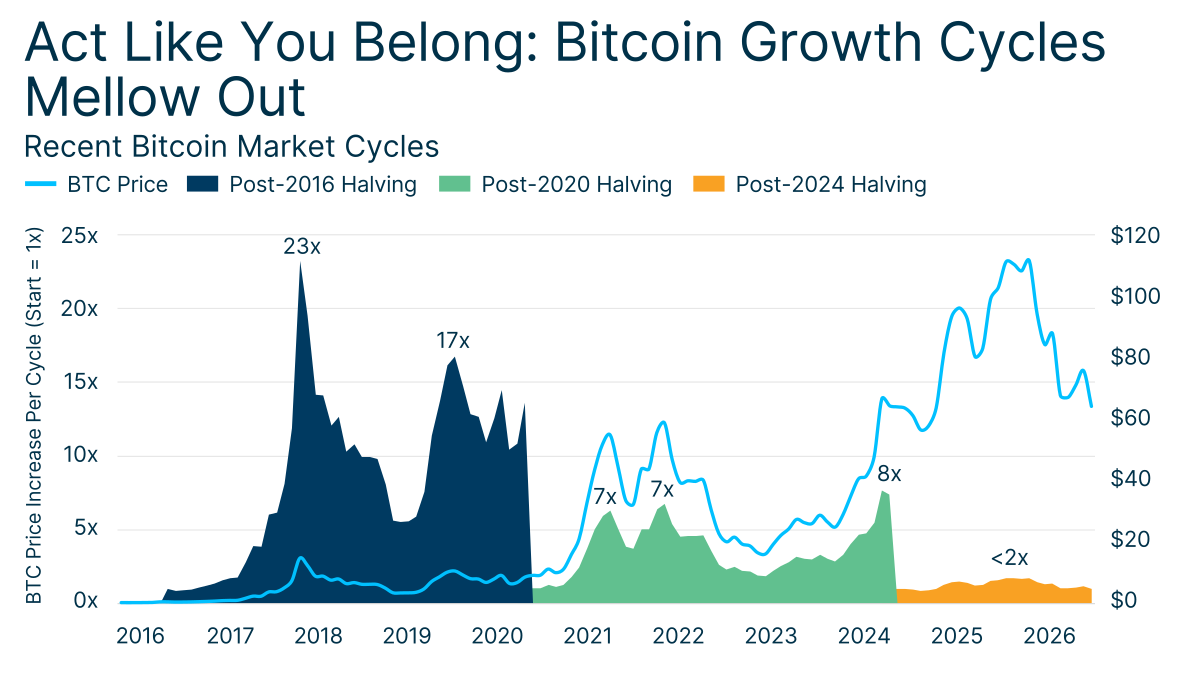
By conventional measures, this latest cycle has underwhelmed. The BTC price spike that coincided with the 2024 US presidential election reversed a bear market, but it was short lived. The rebound fell short of doubling from the prior all-time high and has since given back the gains since the last halving cycle in November 2021. Unlike prior cycles, this bull market also failed to attract meaningful new retail participation. The number of Bitcoin wallets grew from 54 million in 2024 to 59 million in 2026, but the number of wallets holding at least 0.1 BTC has held steady at around 4.5 million since 2023.3 While IPOs and M&A have blossomed, venture capital investment and developer activity have shifted largely toward AI.
But what has occurred might be more impactful than growth metrics suggest.
The latest cycle brought a level of institutional interest in Bitcoin never seen before. In January 2024, the SEC approved the first spot Bitcoin ETFs. BlackRock’s iShares Bitcoin Trust became the fastest ETF to hit $70 billion in assets under management. For the first time, fund managers could acquire Bitcoin exposure through a conventional product they already understood, without the complexity of self-custody.
Engagement between established financial institutions and crypto is evolving. Through the first half of 2026, several major financial institutions had launched Bitcoin-backed lending for select clients.4
Twin tailwinds of clearer regulations – including the passage of the GENIUS Act and the potential passage of the CLARITY Act to follow – and a crypto-friendly administration have created momentum, contributing to increased engagement from financial institutions.
These institutions not only want new customers, but they also want faster settlements and automatic collateral. Bitcoin is increasingly viewed as a highly liquid, fungible asset, often described as having no counterparty risk – though in practice that depends on how it is held or used. The bear market, if anything, has strengthened its case as collateral by providing a pressure test.
From buyer to borrower: The evolution of a Bitcoiner
The main factors driving the growth of Bitcoin-backed lending are the volume and philosophy of the people and companies who require it.
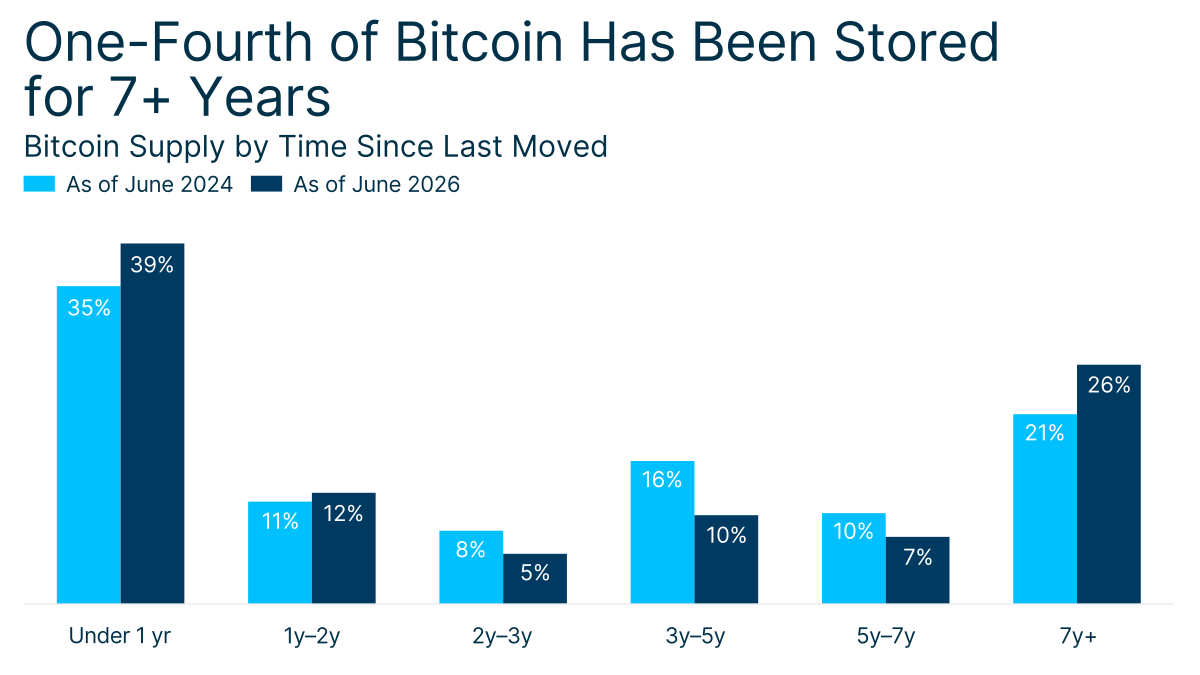
There are now millions of wallets holding Bitcoin for at least five years. In fact, 26% of Bitcoin has stayed untouched for at least seven years, up from 21% in 2024. For many of these holders, Bitcoin represents a primary source of wealth. Many bought early, watched the price swing wildly, and held anyway. Now they need money for a mortgage, to start a business or to pay college tuition. Others just want to buy more Bitcoin at cheaper prices.
We first wrote about this “hodler’s dilemma” last year, describing the growing number of Bitcoin lenders serving this group. Since then, the space has matured. New rated securities have been approved, name brands from traditional finance are participating and the borrower profile is expanding.
To understand how these providers fit in the overall landscape, consider the typical journey of a Bitcoin holder.
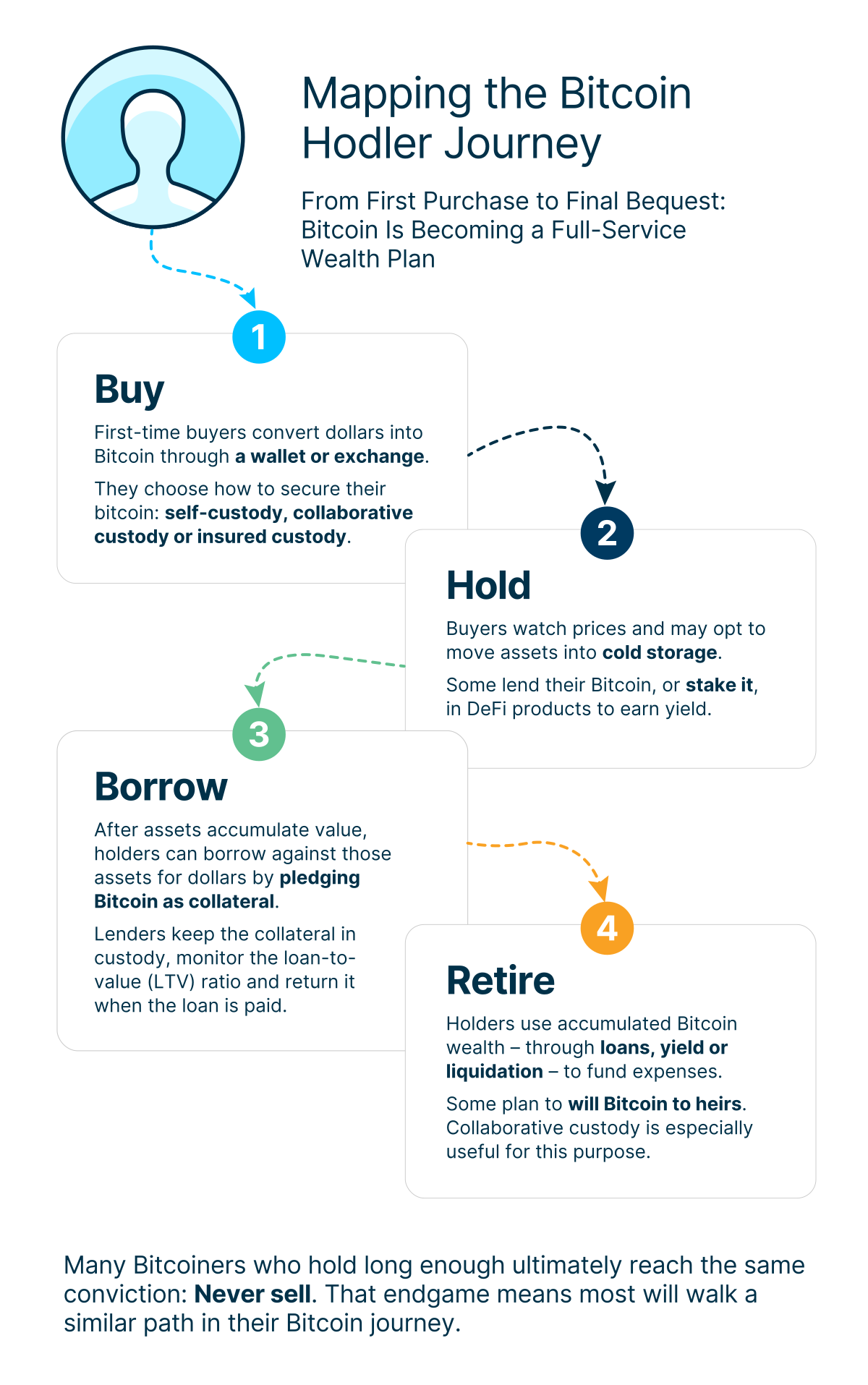
The entry point is the wealth layer. Companies like Unchained, River, Fold and Strike offer a user-friendly front door for those wanting to buy Bitcoin.
Once purchased, Bitcoin can be secured in one of three ways:
- Self-custody, where the customer holds their own private key, typically in a hardware wallet
- Collaborative custody, where the customer holds the Bitcoin but shares access with a vendor
- Insured custody, where a vendor holds the Bitcoin on the customer’s behalf, like a bank
The choice comes down to how much autonomy the customer wants relative to the convenience of managed services.
Next, Bitcoin either goes in cold storage, usually on a hardware wallet locked in a physical safe, or it gets put to work, by either being spent (through payment providers), or collateralized in a credit system.
The infrastructure underlying these applications powers node management, payment routing and developer tools. It is built by a layer of B2B companies that most Bitcoin holders will never directly touch.
Collateralization has undergone the most change in recent years. Products serving Bitcoin holders who need liquidity without selling their assets have ballooned from a handful of crypto-native startups into a market that includes institutional-grade securities and the largest financial institutions.


A shift towards familiar lending structures
Bitcoin-backed lending is starting to look like every other lending market.
In an earlier era, borrowing against Bitcoin meant trusting a crypto-native platform with your collateral and hoping the company was still around when you needed it back. In 2022, the collapses of BlockFi, Celsius and Genesis – each of which had borrowed short and lent long with customer deposits – wiped out about $11 billion in customer funds and set back centralized lending. What has since emerged is a lending ecosystem that prioritizes collateralization and transparency.
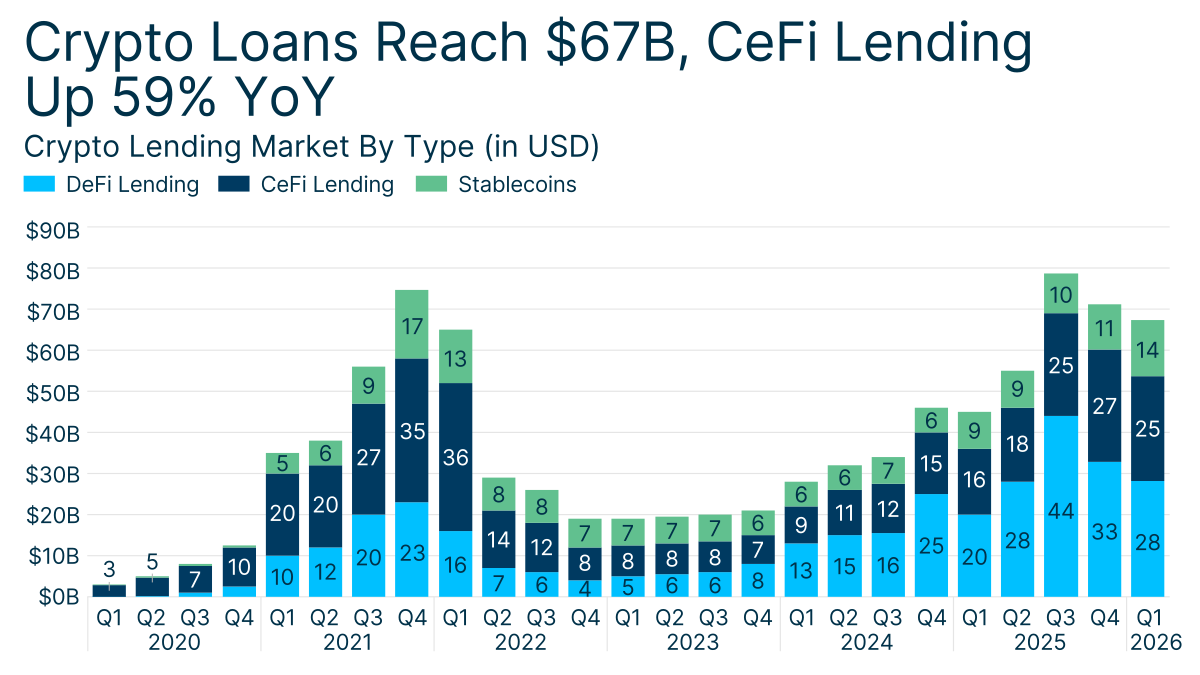
Bitcoin-backed loan volumes have grown steadily since 2023, driven primarily by long-term holders who refuse to sell but need liquidity. Loan volume across all cryptocurrencies totaled $67 billion in Q1 2026, a nearly 50% YoY increase, according to Galaxy Research.
Source: Galaxy Research
At such conservative loan-to-values (LTVs), reported defaults have been rare, liquidations rarer and losses minimal. Unlike the failed platforms of 2022, today’s lenders require borrowers to post significantly more Bitcoin than they borrow in dollars, and they monitor that collateral continuously. When prices drop, the math triggers automatic action before losses can accumulate. In fact, potential deviations from those processes are riskier than the volatility of the asset itself. Bitcoin does not drop 50% overnight, which gives lenders and borrowers time to react.
How Ledn achieved the first rated Bitcoin securitization
The evolution of these lending models can be seen in companies like Ledn, a digital asset financial services provider. Founded in 2018 in Toronto, the company operates in 130 countries and has built a sizable Bitcoin-backed loan book; it reached nearly $1 billion in outstanding loans at its peak.
The business model is straightforward. Ledn takes Bitcoin as collateral, lends dollars against it at conservative LTV ratios and funds those loans through four sources: its own balance sheet, growth accounts denominated in USDC and USDT from non-US customers, bilateral lending arrangements with institutional partners, including Tether, and an ABS sold to institutional investors.
Lenders like Ledn reflect the sector’s shift toward more robust risk management compared to earlier platforms from their defunct predecessors. Despite a 48% drop in Bitcoin prices from the peak reached last year, Ledn reports no losses on its collateralized consumer loans during that period. In fact, in eight years of operations and as of this writing, Ledn has never experienced a loss on a loan.
This reported performance was a key factor in the credit rating process for its ABS. In February 2026, the company closed a $188 million Bitcoin-backed ABS, the first Bitcoin-collateralized lending portfolio to achieve an investment-grade rating from a major credit agency – S&P Global assigned BBB – to the $160M senior class A notes of Ledn Issuer Trust 2026-1.Clearing that bar required demonstrating that both the loan book and underwriting approach met institutional-grade expectations, a notable milestone for the sector.
“S&P didn't rate a narrative – it rated eight years of real performance data across more than $10 billion in originations,” explained Reeds “That track record is the bar, and it’s a high one.”
While still early relative to traditional markets, the deal illustrates how Bitcoin-backed lending structures are beginning to align with established credit frameworks.
Much of the default risk is simply automated away. Borrowers post 200% of the loan value as collateral before the loans are funded. Every loan is continually monitored to ensure it stays above the required LTV threshold, and liquidation triggers automatically at 80% LTV.
Liquidation is the last resort, and Ledn works to avoid it. Customer dashboards and customer reminders track LTV as it rises. Ledn also offers a free feature called “Auto Top-Up,” which functions as a kind of overdraft protection by drawing on a reserve amount of Bitcoin.
“Today we have thousands of loans and those are checked against loans to value every 60 seconds,” Reeds said. “Our loans liquidate at 80% loan to value. It’s just math. Because of that structure in place, we’ve had zero losses.”
Another reason S&P supported the deal was that it functioned like the traditional finance deals they already understand. Not only did Ledn build in loss buffers like cash reserves and overcollateralization, it appointed Fidelity Digital Assets as custodian, a name every institutional investor recognizes. And critically, it included a backup servicer: Zaria.
Why backup servicers matter
In traditional finance, backup servicers are standard. Following the 2008 financial crisis, rating agencies made them a near-universal requirement for rated securitizations. If the primary lender fails, a different entity must maintain margin calls, collect payments and liquidate collateral if necessary. Without a backup servicer, the deal falls apart.
For Bitcoin-backed lending, that role did not exist until recently. Emily Barron, a veteran of SVB, SoFi and NYDIG, spent years trying to complete Bitcoin securitization deals and kept running into the same wall. The backup servicer role was required for many transactions, but had not yet been widely established in crypto markets. In 2025, Barron cofounded Zaria with CTO Keith Dallara – also a former SVBer – to help fill that gap.
“S&P would not have been comfortable without a proper backup servicer being on the transaction,” Barron said.
For institutional investors, separation of roles is important. While Ledn originates and services the loan and Fidelity custodies the assets, Zaria’s role in the Ledn ABS is to serve as both backup servicer and collateral agent.
“Once these capital structures mature,” Barron said, “Bitcoin-backed lending will become a regular asset class – just like autos or consumer lending.”
Zaria also offers real-time administrative, calculation, and verification agent services. These capabilities have increased participation from private credit into crypto-backed lending and allowed for smoother loan syndications and structured credit products in the space.
Collaborative-custody Bitcoin loans
While some firms focus on higher-volume Bitcoin-backed lending, others like Unchained, offer a different model centered on collaborative custody that emphasizes customer control of their Bitcoin alongside financial services.
Unchained’s loan volume is in the hundreds, rather than the thousands, and its collaborative custody model means no single party can act unilaterally.
Loans at Unchained require similar collateral and LTV thresholds to Ledn, but because of the collaborative custody approach, human employees, in addition to code, are needed to execute liquidations.

The profile of borrowers has evolved since Unchained launched, expanding beyond early tech adopters to a broader range of professional classes, including doctors, lawyers and dentists. To meet changing client needs, Unchained has introduced financial services such as tax advising, estate planning and Bitcoin-backed IRAs.
As of June 2026, the company’s website disclosed that loans start at $150,000 and carry a 14%-16% APR, with borrowers using funds for purposes ranging from real estate to business investments. Clients take out money to buy property or make an investment. A cabinet maker bought new tools and retrofitted his garage. Another client bought an airplane. All clients value the security of their Bitcoin. Unchained has also seen increased onboarding following the failures of earlier crypto lenders such as BlockFi and Celsius, reflecting continued demand for Bitcoin-backed liquidity solutions.
Why Bitcoin loans cost more (for now)
One thing Ledn, Unchained and their peers share is cost. Bitcoin-backed loans currently carry higher interest rates higher than what a borrower would typically pay against a home or a stock portfolio. The credit spread premium reflects several realities. Bitcoin’s price volatility demands continuous monitoring that traditional lenders don’t need. Additionally, the market has not yet attracted enough competing capital to compress margins.
Capital allocators are already interested. As more institutional capital enters the lending market –drawn by securitizations like Ledn’s ABS – competition should drive rates down toward something closer to securities-backed lending. Zaria’s expanded agency services could accelerate that process by opening the door to a broader universe of traditional lenders that are not yet participating. Tied together, these threads point toward cheaper Bitcoin lending on the horizon.
Lightning: Lending and payments are two sides of the same (Bit)coin
The same institutional maturity in lending has a parallel with Lightning Network payments. This Layer-2 protocol sits just above the Bitcoin settlement layer. Broadly, Lightning transactions share the same premise as stablecoins: to enable faster and lower-cost settlement in certain use cases. But while stablecoins peg their value to the dollar and operate on a patchwork of networks, Lightning is fixed to Bitcoin. That makes it well-suited for the growing number of Bitcoin-backed companies.
As awareness of the benefits of blockchain-based treasury is growing, companies are becoming more interested in using the Lightning Network. The main constraint is implementation. Converting to Bitcoin-based products takes a shift in company culture.
“Stablecoins embody the speed of settlement and transparency that crypto proponents have always valued, and the other side is now interested in it,” said Graham Krizek, Founder and CEO of Voltage. “The convo has shifted from ‘should we do it?’ to ‘how do we do it?’”
How the Lightning Network works
Rather than record every transaction on the blockchain, which can be slow and costly, Lightning participants open payment channels by locking Bitcoin on-chain, then transact freely off-chain, only settling the final balance to the blockchain when the channel closes.
In traditional finance terms, Lightning is like the interbank lending system, which extends nearly free short-term credit to banks throughout the day to maintain liquidity. Lightning also provides low-cost payment liquidity, but it does so globally 24/7 with counterparty risk that differs from traditional rails because the funds are already secured. Unlike intraday credit, which is generally available to US banks and regulated institutions, Lightning is available to anyone with a node and an internet connection.
Lightning is positioned to add volume. The network has about 5,000 BTC of channel capacity, which means about $350 million worth of BTC is locked into the network and ready to route payments at any given moment. This amount resets itself nearly instantly when a payment clears, allowing the same pool of BTC to settle millions of transactions.
Setting up and maintaining a node is how companies like Voltage thrive. Founded in 2020, Voltage provides enterprise infrastructure for companies using the Lightning Network for transactions.
The biggest users of Lightning today are high-frequency, cross-border applications like iGaming.
To service these businesses, Voltage offers a revolving credit line called “Voltage Credit.” Gaming is a primary use case because it involves many small transactions between the same counterparties repeatedly, often across borders where traditional payment rails are slow, expensive or unavailable. International remittances and creator economy micropayments fit the same profile. But the largest category of untapped potential is stablecoins.
Stablecoins already deliver fast and cheap payments, but they do so across a fragmented patchwork of competing networks that each carry their own fees, settlement structures and security assumptions. Moving among these chains is a notorious security vulnerability that has been responsible for some of the largest hacks in crypto history. Stablecoins on Lightning would collapse that fragmentation into a single network, which would be a win for the ecosystem overall, according to Krizek.
“Stablecoins on Lightning can move faster and cheaper than other chains. There is also that trust and predictability of Bitcoin. Bitcoin is the rail and the tracks for it to run on,” Krizek explained.
For now, this is still a long-term goal. Lightning’s most immediate impact may not wait for stablecoins at all. The very structure that makes Bitcoin loans so reliable for lenders is prime for running on Lightning. Margin calls, collateral posting and liquidations could execute instantly on the network. Borrowers approaching an LTV threshold could post more collateral instantly with the Lightning Network.
On the borrower side, the technical capability is there. Providers such as CashApp, Coinbase and Kraken all support Lightning. The integration of this technology on the lending side is the next phase.
“It’s a chicken and egg problem,” said Krizek. “We’ve come a long way from the borrower side. Now, we need the lenders to support it.”
The road ahead for Bitcoin: Lower rates and broader adoption
Bitcoin has spent much of its existence seeking to prove it belongs. Some now view it as collateral with instant and global liquidity, fast settlement, fungibility and minimal risk. Bitcoin’s next challenge is to scale as a full-service asset class within established credit and payment frameworks. A limiting factor is not only borrower demand, but also consistent access to capital.
As the space becomes more understood, we expect more pockets of private credit, as well as more banks, to provide capital in the near term. Already, we’re seeing signs that costs are coming down. In May, Strike’s unveiling of a 7.5% rate for term loans of more than $5 million is a significant step-down in pricing and a glimpse of where pricing could be headed. Tether extended a $2.1 billion credit facility to expand Strike’s lending efforts. Looking ahead we expect a broader mix of funding sources could lower rates and risks.