



- Protect runway amid escalating travel costs by optimizing travel spend management with policy-driven controls and automated expense reporting to curb burn without slowing growth.
- Reduce expense leakage and fraud risk by guiding employees into compliant spend using virtual cards with custom limits and auto-alerts to ensure approved-vendor bookings.
- Improve cash forecasting by centralizing travel spend on a single commercial card program to gain richer data intelligence for financial planning and board reporting.
Tackling top challenges in managing travel spend as you scale
Optimizing how you manage travel spend is one of the smartest moves for fast-growth companies. It starts with understanding the importance of travel management, which includes controlling and tracking all business travel costs through centralized policies and real-time visibility, custom card controls and automated reporting.
Especially for tech innovators, conferences and events are invaluable to capture leads, drive pipeline, and network for opportunities. But multiple shows and client meetings throughout the year can mean lots of employees traveling, and costs and risk can stack up quickly. Travel spend optimization helps you avoid some pitfalls that can derail your growth.
The key is to put robust spend controls in place – while making it easier for employees to meet travel needs, adhere to budgets and corporate travel policies, and promptly report expenses. In fact, an ROI benchmarking study found that “U.S. companies that take a strategic, well-governed approach to their business travel programs can achieve up to 30% higher revenue than their peers.”
Let’s look at some critical finance challenges that business travel stirs up, and how the right strategies can help you protect runway, minimize expense leakage and fraud risk, and improve forecasting.
Protect runway in a high-volatility cost category
Venture-funded companies need to act fast and seize opportunities to drive growth and profitability. That often means making client trips on the fly, sending executives to speak at industry events, and staffing tradeshow booths. But it also means CFOs face increasing budget pressures for travel spend.
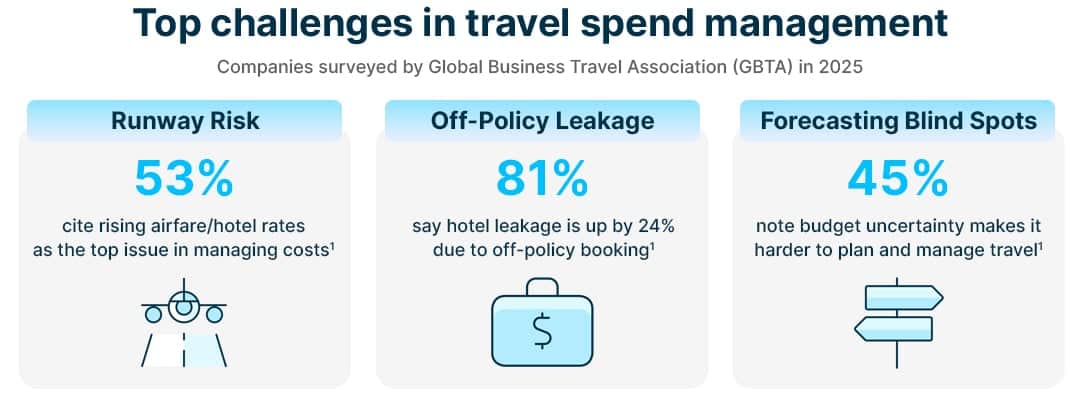
Airfare and hotel rates keep escalating, and 53% of companies consider it the “single greatest challenge” in managing travel costs, according to a GBTA survey. The problem is compounded by last-minute bookings at higher prices, hosting client dinners, and unmanaged T&E purchases. And when travel spend spirals out of control, runway gets shorter and burn rate goes up. In a cash flow crunch, the business may be forced to make hard tradeoffs such as scaling back hiring or GTM efforts.
Optimizing travel spend management is essential. For starters, focus on gaining greater control and visibility by centralizing purchases on a single commercial card program that’s integrated with a spend management platform. And choose a platform that includes travel booking, auto-enforces policies, and automates expense reporting and reconciliation.
Also think about your approved travel vendor list and promote sustainable choices that save costs and reduce carbon. It’s a strategy favored by over 60% of companies (per a Mastercard survey). Savings often come from efficiencies like booking multiple meetings in the same region and encouraging employees to share rental cars or rideshares.
Optimize travel management to reduce leakage, noncompliance and fraud risk
One of the biggest drivers of wasted dollars is “expense leakage”, which is unauthorized spending by employees using their company card outside of approved channels and vendors. GBTA found that nearly 25% of travel managers have seen increases in hotel spend leakage and 20% noted a rise in airfare leakage due to off-policy bookings. In fact, lack of travel policy compliance was ranked as the third most pressing problem.
Sometimes employees aren’t fully aware of which suppliers and expenses are allowed or not. Other times, if choices are too limited, people respond with noncompliance by booking where there’s more flexibility. Whatever the case, more out-of-policy spend can result in more costs, more exceptions, and more time for the finance team to chase down details.
Another crucial consideration is the increased risk of expense fraud. When the finance team has less visibility and spend control (particularly with plastic cards), it can translate into higher fraud exposure. ACFE, a leading fraud organization, found that weak controls are the top contributor to occupational fraud. That means on top of potential lost/stolen cards and compromised transactions, employees might be passing off personal spend as business expenses.
Spend controls that improve compliance
Tightening controls around travel spend can reduce costs and risk. Two tactics I often recommend to clients include:
- Issue virtual cards for travelers with preset budgets for airfare, hotels and meals; and set limits on allowed spend categories and merchant codes. You can also assign start/end dates, so the card can support ongoing travel needs or be limited to a specific business trip.
- Add approved vendor lists to travel booking within the spend management system. While not all providers support this, SVB’s platform can automate rule-based alerts to maintain travel policy compliance. For instance, it can block purchases (or require exception approval) if users attempt to book with non-approved vendors or airfare/hotel rates exceed specific thresholds.
These compliance controls do more than keep a rein on travel spending. They enhance the employee experience by making it easier for people to understand where, how and how much they can spend.
It’s a pivotal strategy that many businesses are adopting. 60% of companies are increasing booking compliance to control travel costs, according to a Deloitte study. And more than 6 in 10 firms “embed T&E policies into online booking to flag employee choices as falling within or outside company policy,” notes Mastercard.
Improve cash forecasting with centralized visibility and control
One other pitfall that gets overlooked stems from having travel bookings and other T&E purchases scattered across corporate and personal cards. It means the finance team has limited visibility plus gaps and delays in transaction data, so they are missing vital spend intelligence. They can’t answer basic questions quickly, like “What did we spend last month by team and vendor?” Fragmented travel spending also requires more time for expense reporting, reconciliation and reimbursements to get to month-end close – and those costs eat into your runway and margins.
Finance intelligence becomes a much bigger deal as you scale. CFOs need to ensure budgets are based on real-time insights, not guesswork. And cash forecasting and board reporting needs to be grounded in complete and accurate information to support profitability projections and investor confidence.
Solving the data challenge circles back to my earlier advice to centralize business travel spend on a single commercial card program. This approach not only simplifies reporting and reconciliation, it centralizes payment data to deliver richer analytics for more accurate forecasting and cash flow optimization.
Managing travel spend at scale is significantly easier with the right capabilities and best practice guidance. SVB commercial cards and AI-powered spend management gives you robust controls and automated workflows that help your business boost efficiency and policy compliance to keep your costs and cash flow on track for growth.
Venture-backed companies choose SVB card solutions because they are built for the needs of fast-growth innovators and supported by experts who understand their business. If your current spend management provider is getting acquired, now is a great time to explore the SVB difference
Frequently Asked Questions
How do we prevent travel costs from eroding runway as we scale?
Centralize travel purchases in one travel spend management workflow, using an expense management platform with integrated booking. You can auto-enforce policies and approved vendors, issue virtual cards with custom limits, and automate expense reporting. Employees can easily and compliantly meet travel needs, and the finance team gains real-time visibility and cost control.
Why are we seeing “leakage” even with travel policies in place?
Expense leakage (when employees with corporate cards spend outside of approved channels and vendors) often occurs when staff is unclear about what’s allowed or not, or options are too limited, so they book travel on other channels. To reduce out-of-policy spend and exceptions, provide approved-vendor lists built into booking, automated policy alerts, and virtual cards that restrict spending to designated categories and merchants.
How do we improve travel policy compliance without creating friction for employees?
Issue customized virtual cards with preset budgets, dates, spend categories and merchant codes. Pair the cards with travel booking that provides auto-alerts on approved vendors and policies, so employees are guided into compliant choices. And mobile expense reporting can provide policy alerts, such as reminding card users when transaction limits require receipts.
How can we get better travel data for cash forecasting?
Centralize fragmented travel spend (across corporate and personal cards) onto a single commercial card program. And use a card with an integrated spend management platform that includes travel booking. It enables you to capture more complete, real-time transaction data for detailed spend analytics to improve cash forecasting.
