



- AI for startups is a practical tool that helps early-stage founders move faster, automate low-value work and focus limited time and resources on the strategic decisions that drive growth.
- From financial forecasting to pitch decks and investor research, AI can act as a practical co-pilot that improves clarity, iteration speed and decision quality without replacing founder judgment.
- Startups that learn to collaborate effectively with AI can gain a competitive advantage in building, fundraising and scaling in an increasingly complex and crowded market.
Artificial intelligence (AI) for startups is the use of AI-powered tools, including large language models (LLMs), automation platforms and data analysis software, to help early-stage founders build, fundraise and scale with fewer resources. For early-stage startups, AI has become one of the most versatile tools in a founder’s toolkit.
While AI can bring to mind futuristic visions of robots or fully autonomous cars, the reality on the ground is far more practical and powerful. Today’s founders are using AI to move faster, make smarter decisions and stretch limited resources further than ever before.
From automating operational work, creating eye-catching collateral and sharpening fundraising strategies, AI is reshaping how startups are built. In this article, you’ll learn how startups use AI to reach key startup milestones such as building a financial forecast, creating a pitch deck and reaching potential investors.

Why use AI for financial forecasting?
Financial forecasting focuses on predicting specific financial outcomes based on current and past data. The four types of financial forecasts typically include sales forecasts, expense forecasts, breakeven analysis and cash flow projections.
Building a financial forecast is a critical milestone for early-stage founders, yet many struggle to translate assumptions into a coherent model. Additionally, most founders are challenged by the time-consuming aspect of building a financial forecast.
By analyzing historical data, assumptions and market benchmarks, you can use AI tools to model cash flow, forecast revenue and identify potential funding gaps quickly.
How can you use AI to prepare a financial forecast?
AI can act as a financial co-pilot, helping you structure forecasts, pressure-test assumptions and identify risks. This is a practical example of how businesses use AI to accelerate startup milestone achievement.
You can use AI to:
- Generate baseline financial models based on industry benchmarks
- Translate operating assumptions into revenue and expense drivers
- Run scenario analyses (best-case, base-case, worst-case)
- Identify potential cash-flow gaps and runway risks
Here’s a suggested LLM prompt to get you started:
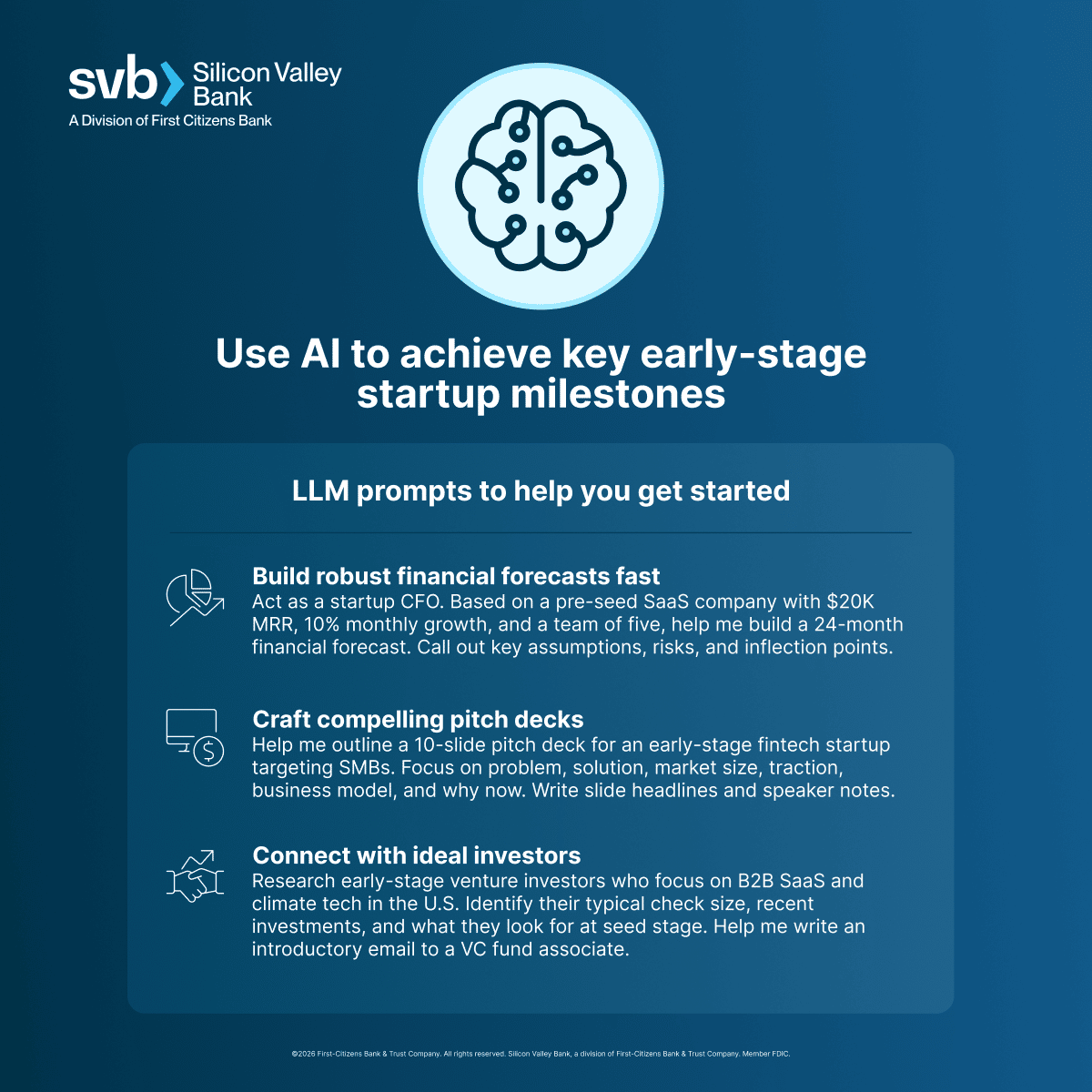
Act as a startup CFO. Based on a pre-seed SaaS company with $20K MRR, 10% monthly growth, and a team of five, help me build a 24-month financial forecast. Call out key assumptions, risks, and inflection points.
While AI can provide powerful insights into your financial forecast, you may still want to compare the AI-generated data with a financial forecasting platform or consult an expert.
Why use AI to create a pitch deck?
As an early-stage startup founder, you can use AI to create a pitch deck to accelerate the process of shaping a clear, compelling narrative. AI can help you translate complex products and early traction into concise, investor-friendly language while keeping your story focused on the challenge in the marketplace, how your solution provides the answer as well as the market opportunity for your solution.
Instead of starting from a blank slide, you can quickly generate structured outlines, headlines and talking points that reflect how investors evaluate companies. AI can also enable rapid iteration and sharper positioning for fundraising conversations. You can test different value propositions, market angles and traction narratives in minutes, not days, and refine your deck based on feedback without constantly rebuilding slides.
How can you use AI to create a pitch deck?
A strong pitch deck is less about flashy design and more about clarity, narrative and credibility. AI can help you craft and refine your story before you even open PowerPoint or Keynote.
AI can assist with:
-
Structuring a logical pitch flow
- Drafting concise slide headlines and talking points
- Translating technical products into investor-friendly language
- Refining the value proposition and market narrative
Rather than starting from a blank page, you can iterate quickly, testing different story angles and messaging strategies.
Here’s a suggested LLM prompt to get you started:
Help me outline a 10-slide pitch deck for an early-stage fintech startup targeting SMBs. Focus on problem, solution, market size, traction, business model, and why now. Write slide headlines and speaker notes.
It’s a good idea to have an expert or trusted advisor review the pitch deck you created using AI before going to investors with it. While AI is a powerful tool, there’s no substitute for having knowledgeable people you trust review your pitch deck.
Why use AI to reach potential investors?
AI helps startup founders raise capital by accelerating investor research, refining outreach messaging and stress-testing pitch narratives. Used well, AI doesn’t replace founder judgment, it augments it by providing clearer insights and faster iteration.
Finding the right investors is as important as raising capital itself. AI can dramatically speed up investor research by synthesizing public information, identifying patterns and aligning investor focus with a startup’s stage and sector. You can also use AI to develop a venture capital outreach strategy and draft introductory emails that contain the information VCs need when making investment decisions. This type of fundraising automation can help founders save time while improving outreach quality.
How can you use AI to reach potential investors?
VCs are busy, and they won’t always have time to meet with a pre-seed or seed-stage company. It's a better strategy to open lines of communication with VC fund associates. For an early-stage founder, building relationships with VC fund associates is often far more strategic than trying to jump straight to a partner.
Associates are typically responsible for sourcing new deals, doing first-pass diligence and deciding which companies make it into a partner meeting. They are actively looking for promising founders, tend to be more accessible and are incentivized to develop conviction early, long before a firm’s senior investors get involved. Establishing an open, ongoing dialogue with associates could give you multiple chances to refine your story, share progress and stay top of mind as your company evolves.
You can use AI to reach investors by:
- Researching investor theses and portfolio patterns
- Identifying investors active at a specific stage or geography
- Drafting personalized outreach messages
- Preparing for investor meetings by anticipating questions
Using AI can make investor outreach more targeted and strategic thus saving time and improving fundraising outcomes. It acts as a type of startup growth tool that can give you a competitive edge in a crowded fundraising environment.
Here’s a suggested LLM prompt to get you started:
Research early-stage venture investors who focus on B2B SaaS and climate tech in the U.S. Identify their typical check size, recent investments, and what they look for at seed stage. Help me write an introductory email to a VC fund associate.
Conclusion
AI is reshaping how early-stage startup companies grow, fundraise and scale. From automating operations to building financial forecasts, pitch decks, and investor pipelines, AI can help you do more with less. As these tools continue to evolve, startup founders who learn how to collaborate effectively with AI will be better positioned to move faster, make smarter decisions and navigate the complex journey from idea to scale.
