


When most people think about space and defense, they think of SpaceX.
For good reason. SpaceX has helped redefine what is possible by a commercial company in modern space technology. By demonstrating that venture-backed space companies can attract significant capital, generate revenue, achieve scale and generate liquidity for investors it bolstered investor confidence in the category as a whole.
Beyond SpaceX, there is an emerging ecosystem focused on space tech impacting the defense sector.
To better understand the relationship between venture investment and government adoption in defense-focused space technology, we combined venture funding data with Obviant’s government contracting intelligence on 89 US-based, venture-backed space companies that have raised several million of institutional venture capital and received at least one Department of Defense (DoD) award or obligation. (Read more about our methodology below.)
What emerged was a picture of a market that looks very different than it did a decade ago.
Launch has become more accessible, venture investors are more willing to back defense-related businesses, the Space Force has elevated the domain, and government buyers are looking to emerging companies for new technologies while adopting procurement mechanisms that support earlier-stage innovation.
Taken together, these shifts have transformed space from an emerging niche into a growing market where venture capital and government demand increasingly reinforce one another.
Venture capital and government demand are becoming more closely linked
One of the clearest findings from the analysis is the increasing alignment between private investment and government adoption.
Investor appetite for space technology generally has skyrocketed in recent years. According to the Seraphim Space Index, global investment reached $7.5B in Q2 2026, the second-largest quarter on record, while trailing 12-month investment reached an all-time high of $23B. By comparison, global quarterly investment was closer to $1-2B less than a decade ago.
That growth reflects a trend that some investors and industry participants identified years ago as commercial space technologies became increasingly relevant to defense and national security priorities
“A decade ago, IQT built its space technology thesis around a clear premise: technologies developed for commercial space would keep evolving in ways that made them essential to national security, and that convergence would draw increasing private capital,” said Kevin Schaeffer, SVP of Technology at IQT. “We understood early how quickly both the technology and the funding were advancing, which is why today’s level of investment comes as no surprise.”
This perspective aligns with what we see in the data. Investment growth is only part of the picture. Space technology is also seeing strong interest from government buyers, as reflected in venture funding, government obligations and award activity.
This naturally raises a question: Are venture dollars creating companies that command government demand, or is government demand attracting venture dollars?
The data does not definitively answer that question. Historically, government demand often preceded private investment as the leading funder of these technologies via channels like the Small Business Innovation Research program. Today, however, investors are increasingly willing to fund promising technologies before substantial government adoption occurs.
The result is a reinforcing cycle. Government contracts provide a clearer path to revenue and scale, while venture capital gives companies the resources to develop technologies that address future government and defense needs.
The space tech opportunity is larger than many realize
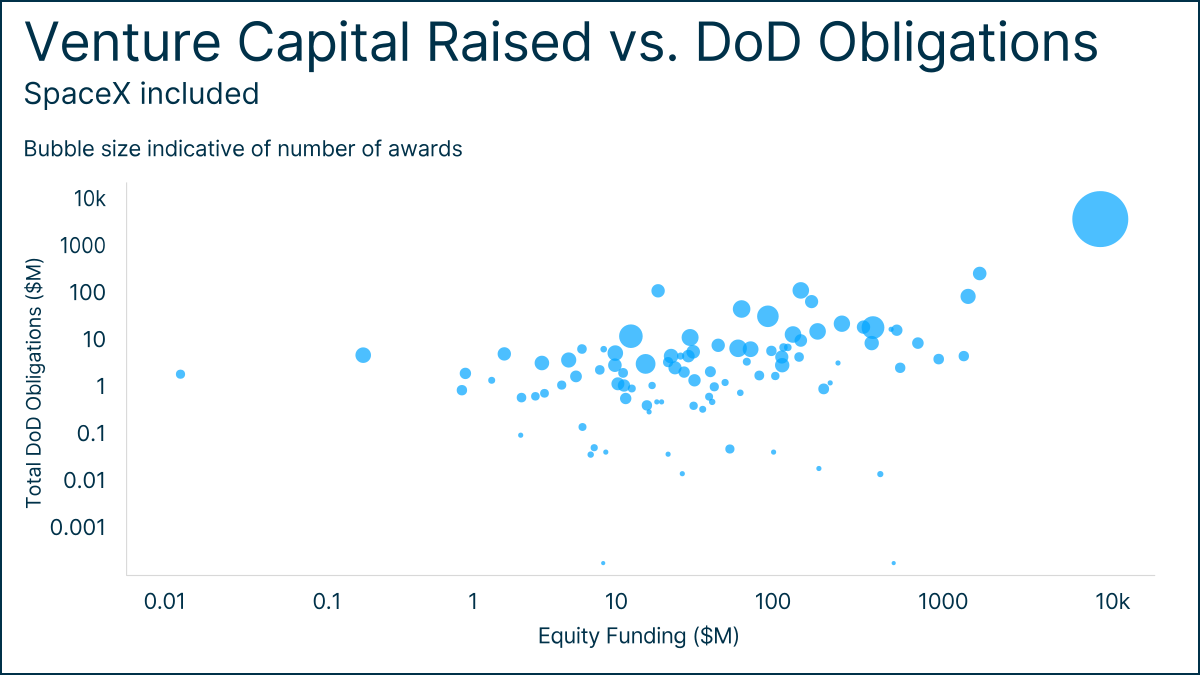
The relationship between venture capital and government adoption becomes especially clear when comparing funding levels with DoD obligations.
SpaceX occupies a category of its own. Its position in the upper-right corner of the chart below reflects a scale that few companies can match.
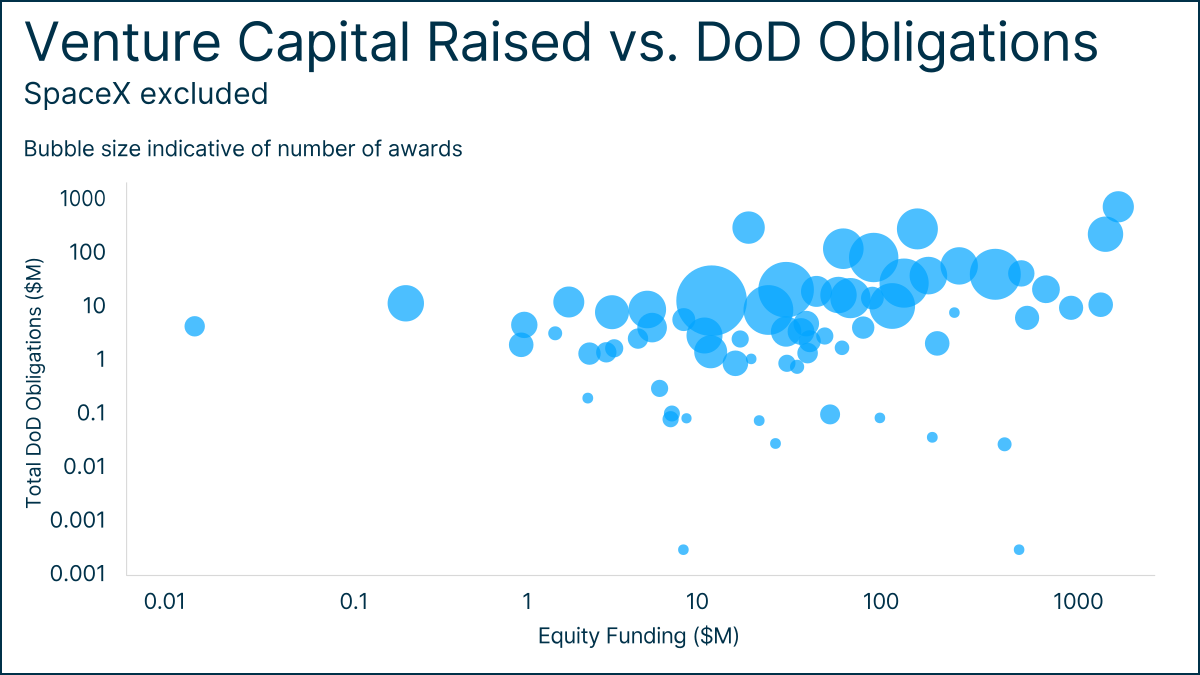
But the more revealing view may be what happens after removing the industry’s largest outlier.
Without SpaceX, a broader ecosystem comes into focus. The chart continues to show dozens of venture-backed companies attracting capital, winning awards and generating meaningful government revenue often enabled by SpaceX capabilities and continued economies of scale in launch.
The data suggests that success in defense-focused space technology is no longer limited to a small number of category leaders. A wider group of companies is finding pathways to growth through a combination of private capital and government adoption.
Government adoption is expanding across procurement channels
If the funding-versus-obligations charts show where the sector stands today, the award data shows how quickly it got there.
Obligations by award type show one clear pattern: rapid growth across nearly every category. This level of activity barely existed before; venture-backed space companies now receive substantially more obligations through multiple pathways, and the trend holds even when SpaceX is excluded from the analysis.
The award data also highlights an important progression. The DoD is increasingly utilizing other contracting mechanisms to work with early-stage companies including OTAs and SBIRs.
"The data has shown that the Department of Defense has brought in larger cohorts of new entrants each year over the last decade, and increasingly at larger initial contract values,” said Greg Arcuri, Research and Analysis Lead for Obviant. “This is a trend we're seeing beyond just the commercial space market, especially as the use of OTAs has become more common across the Pentagon."
This shift may matter more than the dollars themselves. Participation in established programs signals repeat customers, recurring revenue and a greater likelihood of follow-on work. In other words, it often represents the transition from proving a technology to building a scalable business and long-term supplier relationships.
The data also points to a broader change in how government agencies engage with innovation. Newer award vehicles have opened pathways for emerging companies to compete and win business. That doesn't mean the government is abandoning legacy suppliers, but it does indicate that it’s increasingly willing to engage with earlier-stage businesses developing relevant technologies.
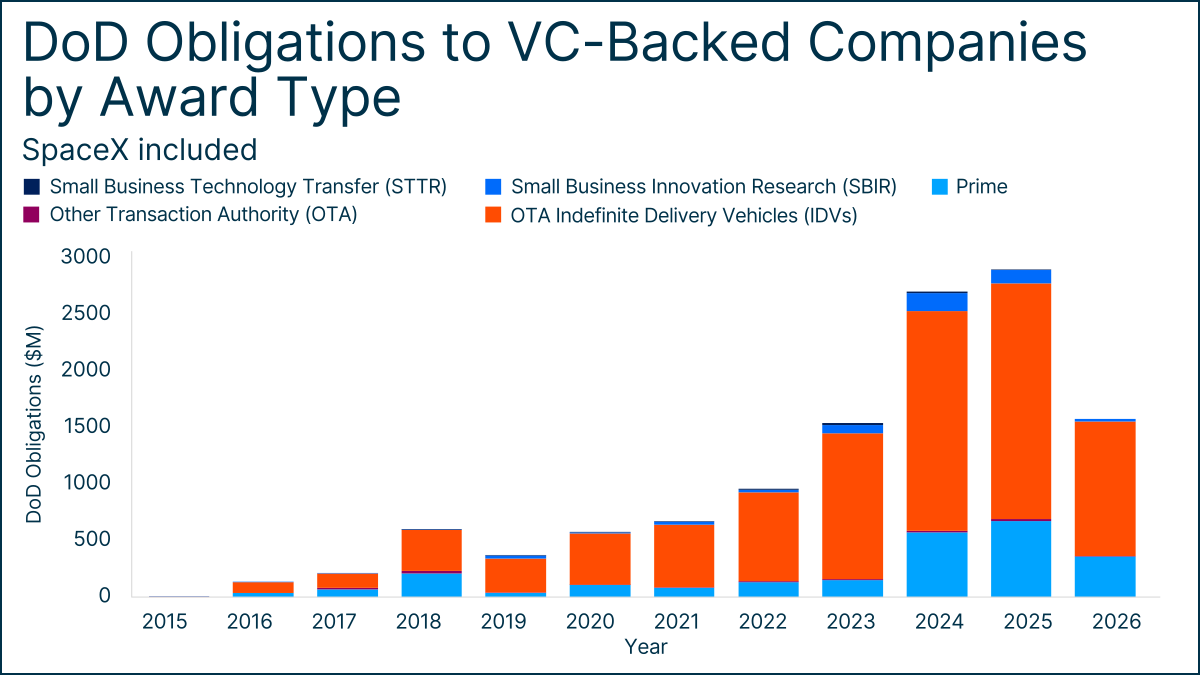
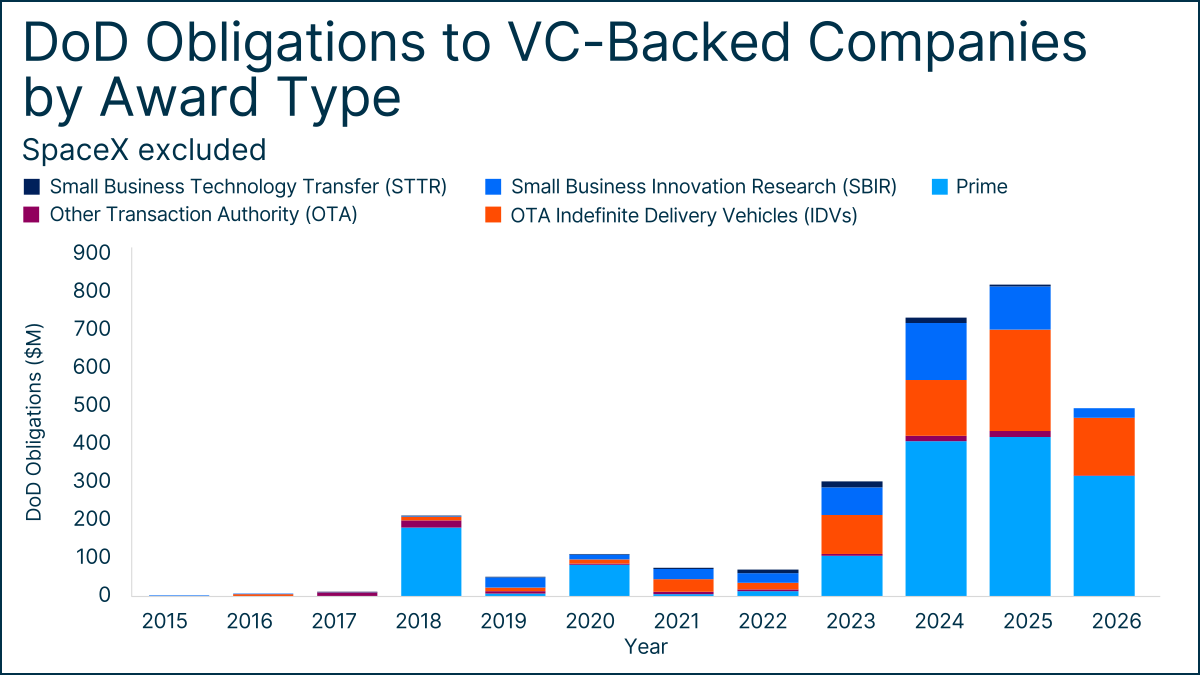
Note: Transaction-year obligations. Prime awards through 8/14/2026. OTA through 6/30/2026 and OTA orders/IDVs through 5/12/2026.
Sources: Obviant, PitchBook Data, Inc. and SVB analysis.
More than a single star
A common perception in defense and space technology is that funding and contracts are concentrated among a handful of well-known companies.
Recent consolidation across the industry and SpaceX's position in the data can reinforce that view. At the same time, improved access to venture capital and a growing willingness among government agencies to work with new entrants have expanded opportunities for emerging companies.
The data shows dozens of venture-backed companies securing capital, winning awards and generating government revenue. The fact that 89 companies emerged in our analysis highlights how much the market has evolved.
What this means for founders and investors
The goal of this analysis was simple: to better understand what's happening at the intersection of venture capital and government demand in space.
What we found was a market with significant momentum.
A market that was still relatively nascent less than a decade ago now supports dozens of venture-backed companies attracting both private capital and government customers. Venture funding is growing. Government obligations are growing. More companies are securing awards and participating in established procurement programs.
SpaceX remains the defining success story. But perhaps the most important finding is what happens when SpaceX is excluded from the data.
The momentum remains.
Seven or eight years ago, this level of venture investment and government activity in defense-focused space technology would have been difficult to imagine.
And that may be the strongest evidence yet that space has become one of the most investable domains within defense technology.
Acknowledgements
Special thanks to Greg Arcuri and Brendan Karp of Obviant for their collaboration and support in developing this analysis. Beyond providing access to government contracting data, they shared the analytical framework, industry expertise and perspectives that helped shape the visualizations and interpret the trends discussed throughout this article. We are grateful for their partnership and contributions to this work.
About Obviant
Obviant is a defense data intelligence platform that provides a single source of truth for US defense acquisition, contracting and budgeting data. By synthesizing thousands of structured and unstructured sources and combining open-source intelligence with customer data, Obviant helps organizations identify opportunities, track market activity and align capabilities with mission needs. Learn more at www.obviant.com.
Methodology
Analysis includes US-based, venture-backed space technology companies that raised at least $4M in equity funding during the previous two years and received at least one Department of Defense (DoD) award or obligation between Jan.1, 2015 and May 31, 2026. Government contracting data was provided by Obviant. Results are dependent on publicly available contract and obligation records and may vary based on agency reporting practices, contract structures and award classifications.
Space technology companies were defined as firms whose products or services directly support space-based operations, launch systems, satellite infrastructure, space-domain awareness, orbital services or related enabling technologies. We applied a $4M financing threshold to focus on companies with demonstrated investor support and sufficient operating scale. The final dataset included 89 qualifying companies.