



- Make in-policy travel spending easy for employees while enabling greater financial control, with integrated booking in your spend management platform and customized travel cards.
- Optimize travel spend controls by creating role-based corporate travel policies and issuing trip-specific virtual cards to help keep budgets, visibility, and cash forecasting on track.
- Automate travel spend management end-to-end, including policy-guided booking, tailored virtual cards to automate purchase alerts and expense reporting, then auto-sync card data to your ledger for faster, more accurate reconciliation.
How can startups optimize travel spend management?
Travel is often an essential part of doing business. And for fast-growth startups, it can also become a real problem. As companies scale up, business travel usually ramps up as well, and so do the finance challenges. With more employees on the go for client meetings, conferences and training events, it gets more critical for the finance team to effectively manage travel expenses. That means putting in place hyper-efficient controls for spending, compliance, and expense reporting. It’s your ticket for greater productivity and better cash flow, and that’s good for your business.
Working with innovation economy clients, I recommend a few best practices for managing travel spend that can make a measurable difference:
- Use a commercial card and spend management platform with integrated travel booking.
- Issue virtual travel cards with role- or trip-specific limits.
- Enable mobile expense and receipt submission to automate reporting and reconciliation.
Let’s walk through what that can mean for your business.
3 corporate travel best practices to manage expenses
Travel spend management is about more than airfare and hotel rates. There are also operational costs that stack up when employees are spending off-policy and out-of-pocket. Plus, productivity costs in hours spent on manual expense reports, chasing down receipts, and reconciling travel spending into reliable audit trails.
The following corporate travel best practices can help fast growing companies simplify processes, while increasing cost controls and oversight to better support your growth.
1 – Make “in-policy booking” the easiest path for travel spending
When employees handle T&E spending across various corporate and personal cards, it’s harder for the finance team to enforce travel policies and constrain how and how much people can spend. It can lead to unexpected cost spikes, such as last-minute airfare for urgent meetings or excessive expense for entertaining clients. Another common problem is airline or hotel bookings with non-approved suppliers. Maybe employees don’t know which ones are approved, or your preferred-vendor list is too limited, so people book via OTA sites to access more options.
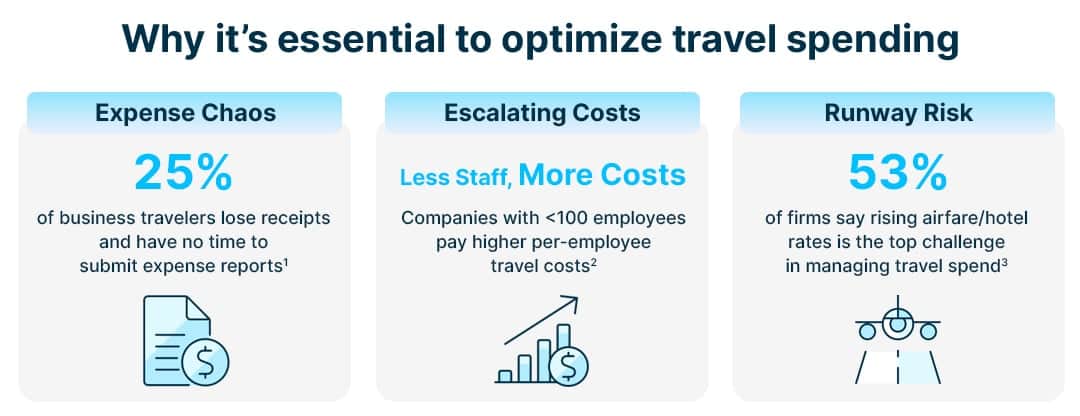
Then there’s the hassle of reporting travel expenses. Business Travel News noted that 25% of travelers lost receipts while on the go, and about a quarter of employees say they can’t find the time to submit expense reports.
The net effect is that uncontrolled travel spending leaves the finance team flying blind and puts cash flow at risk. The answer isn’t about making booking policies more rigid. Instead, the best practice is to make it easy, fast and flexible for employees to keep travel spend in-policy and on-budget. And it’s easier than you think with a few key capabilities:
-
Leverage a spend management platform with integrated travel booking. For example, SVB’s platform enables you to set up an inventory of approved vendors and policy-guided booking, such as fare caps, hotel limits, pre-trip approvals and more. You can also automate alerts to block attempts at off-policy bookings or require exception approval.
- Issue customized virtual cards for travel. Distribute custom expense cards per traveler, with preset budgets for airfare, hotels and meals, approved merchants and more. Using virtual cards also makes expense reporting a breeze. With a mobile app, staff can easily submit receipts and notes as they spend, which helps avoid reporting issues and delays. It also optimizes finance workflows with an automated, real-time stream of card data for fast reconciliation, instead of having to wait for a flood of reports at month-end.
Increasing compliance helps you lower risk and costs, which supports more sustainable growth. And streamlining processes with in-platform booking and automated expense reporting frees up your teams to focus on the work that matters most.
2 – Optimize travel management controls by traveler, team, and trip
The next best practice puts a granular focus on managing limits for business travel spending across individuals, departments and use cases. The goal is to make it easy for employees to meet travel needs but do it in a way that the finance team has full visibility and budget control to keep cash management on track.
Think it isn’t necessary for smaller companies? According to the GBTA, “Firms with under 100 employees spend less overall but face higher per-employee travel costs, reflecting a heavier relative burden and a stronger dependency on travel as a growth driver.”
Consider implementing these commercial card strategies to better manage travel expenses:
- Create role-specific T&E spend policies and card limits. For example, executives need agility so you might allow booking business/first-class for long-haul or last-minute flights, and higher budgets for premium hotels near client meetings. For the sales team, speed may be a factor so you could pre-approve booking pricier options if it saves X hours or enables same-day client meetings and require approvals for exceptions. If you have field operations where certain staff travels on predictable cycles, you could preset card budgets for preferred hotels near job sites, daily meal allowance, rental cars and so on.
-
Issue trip-specific expense cards. Create customized virtual cards for specific business trips that are valid only for fixed start/end dates, have preset per-transaction and daily limits, specified spend categories and so on. Then streamline travel arrangements using virtual cards with the spend management platform’s integrated travel booking, which can auto-approve purchases and automate reconciliation. An added benefit is that virtual cards are significantly safer than plastic. No worries about lost/stolen cards, and they use unique random numbers, so your main card account stays protected even if a virtual card number gets compromised.
- Control approved vendors with Merchant Category Codes (MCC). Create allow/deny vendor lists for airlines, lodging, rideshares, luxury services like spas, etc. You can then embed MCCs and allowed spend categories into virtual travel cards. It also ensures more accurate reporting with correctly coded expense data flowing into the spend management platform.
Optimizing travel spend management can deliver big wins for controlling costs – and more. Issuing cards customized per traveler, team or trip also captures richer data on spending patterns to inform updates in policies, card limits, and cost forecasting.
3 – Automate travel spend reconciliation end-to-end
In the current age of AI-everything, companies increasingly look to automation, including for managing travel expenses. In fact, automation in travel management is on the rise. Nearly 40% of large organizations are automating travel spend pre-approvals and expense reporting, according to a Forbes Insights study.
As a corporate travel best practice for fast-growth companies, end-to-end automation is a no-brainer. It gives you a faster, easier, more scalable process to meet travel needs and ensure accurate audit trails. With the right spend management platform, you gain robust capabilities to create a streamlined, standardized workflow from bookings to card purchases to expense reporting to ledger sync.
Starting with travel arrangements, in-platform booking enables you to auto-enforce policies and block spend on out-of-policy vendors. And you can auto-approve airline, hotel and rental car purchases that meet your criteria.
When travelers use virtual cards, the platform can automatically push alerts to the mobile app to avoid off-policy purchases and reminders to submit expenses and receipts. Then in a few taps, employees can submit expense notes and receipt images for each transaction, and the system automatically generates an expense report that is sent directly into the platform. At the same time, the system captures complete transaction data and any embedded expense codes. It enables the finance team to reconcile quickly with a complete and detailed picture of each person’s travel spend.
From there, the final leg in the automation workflow is to have card data from the platform automatically sync to your ledger in another financial system. With SVB, clients can easily integrate with their preferred accounting software or ERP. Auto-syncing data eliminates the extra time spent and potential errors of manual entry between systems.
Enabling end-to-end automation for travel spend management helps your teams stay agile, save time, and close monthly books faster.
Optimizing how you manage travel spend helps your company stay agile and cash efficient as you grow. Learn how an SVB commercial card program and our AI-powered spend management platform gives you the flexible controls and automated workflows to keep your teams moving forward.
Innovation economy companies choose SVB card solutions because they are built for the needs of startups and fast growth companies and supported by experts who understand their business. If your current spend management provider is getting acquired, now is a great time to explore the SVB difference.
Frequently Asked Questions
How do we make it easy for employees to ensure in-policy travel booking?
Make the compliant path the easiest: use a spend management platform with integrated travel booking that enables you to create policy guardrails like approved vendors, fare caps, automated pre-approval rules, etc. And give business travelers customized virtual cards for booking, which automates reporting and reconciliation to save time and avoid the need for reimbursements.
Should we create role-specific rules for travel spend management?
Yes, tailoring T&E expense policies and commercial card limits and approvals by role (e.g., executives, sales team, field operations) can help the finance team control travel spending appropriate to job responsibilities and travel patterns, while ensuring employees have the budget and agility they need.
How can we prevent random vendor bookings and still give travelers options?
Embed approved-vendor lists for travel booking in your spend management platform, and provide enough options so employees are less inclined to go off-platform to book arrangements. You can also create Merchant Category Code (MCC) rules and assign codes to customized virtual cards for travelers. It gives employees flexible options yet automates alerts to block off-policy spending.
How can we automate travel expense reporting?
Enable employees to use a mobile app integrated with your spend management platform. With the app, users can submit expenses and image-captured receipts, and the system automatically generates an expense report in the platform. Reporting data can then auto-sync from the platform to your accounting ledger or ERP (if integrated) for faster, accurate reconciliation. You can also issue pre-approved virtual cards for in-platform travel booking, which automatically reports and reconciles purchases for airfare, hotels and rental cars.
